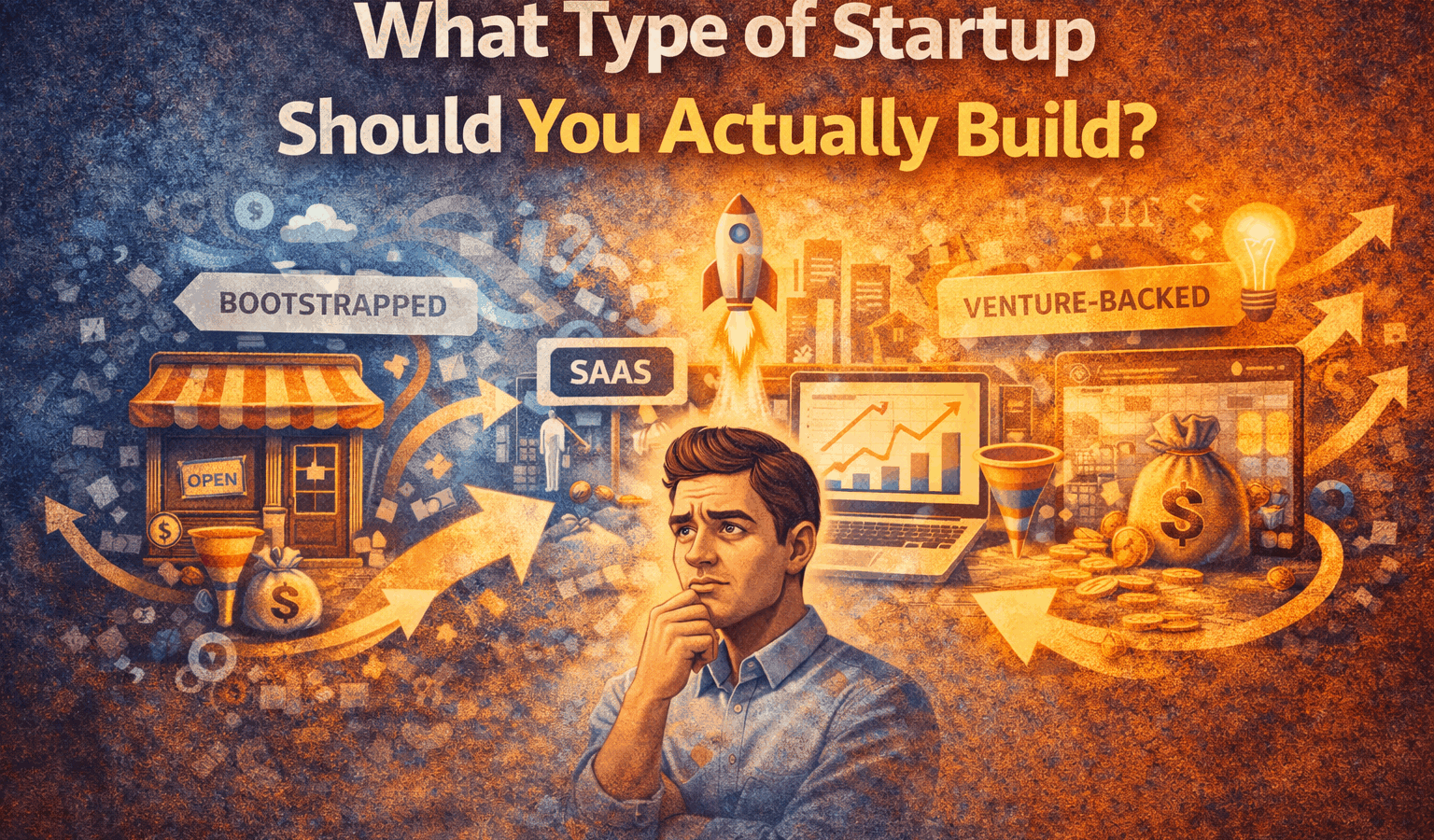
it depends on how fast you want to grow, how much you’re raising, and whether you’re willing to show your hand early. Most founders don’t realise there are genuinely different startup models with different rules — and picking the wrong one wastes years, and usually a significant chunk of budget along the way.
Book discovery call for your startup
Most people use “startup” to mean any young company with ambition. That’s technically fine, but it papers over real differences. A startup meaning, in the strict sense Y Combinator uses it, is a company built to grow fast. Not just “fast for a small business.” Fast on a scale that most business owners would find uncomfortable — think 10% week-on-week in the early months. That definition matters because it shapes every decision: who you hire, what you charge, whether you take VC money at all. It also determines how tightly you need to track what’s actually driving that growth, because at that pace, gut-feel decisions compound badly.
Startup news moves in cycles, and right now the dominant one is series funding. Seed rounds, Series A, Series B — each signals that investors believe the company can reach the next stage without imploding. A startup series isn’t just about the money; it’s a public commitment to a growth trajectory. Miss it and you don’t just disappoint investors. You spook your next round before it starts. What most founders don’t talk about is that investors scrutinise marketing efficiency hard at Series A. CAC, payback period, attribution clarity — they want to see a machine, not a collection of campaigns. Companies that can’t show clean numbers on where their revenue came from routinely leave money on the table in those conversations.
Eric Ries wrote The Lean Startup back in 2011 and the core idea still holds: build the smallest thing that tests your real assumption, measure what actually happens, then decide whether to change direction or push harder. The lean startup method saves money, obviously. But the bigger benefit is time. The problem is that “measure” is where most lean teams cut corners — they track clicks and sessions instead of actual revenue. A Lagos-based lending startup Mowsix worked with had spent ₦1M monthly on Meta ads with no reliable way to know which campaigns drove completed loan applications. Their dashboard, CRM, and finance team showed three different numbers. Once the measurement was fixed, they got to a verified 4.1× ROAS in 10 weeks. The build-measure-learn loop only works when the measurement part is honest.
Stealth startup culture sits at the other end of the transparency dial. Some founders keep everything private — no press, no LinkedIn posts, sometimes no public website — until they’re ready to launch with a polished product. The logic makes sense in theory: protect your idea, finish the work, then announce. The problem is that most good ideas benefit from early friction. Real users break things in ways no internal team predicts. A stealth startup that avoids that friction often spends 18 months building something users didn’t want. There are exceptions, particularly in deep tech and biotech where competitor visibility matters. But for most B2B SaaS and consumer apps, stealth is a confidence-building story founders tell themselves while avoiding the uncomfortable work of talking to customers early.
The startup model you choose should match the market you’re entering, not the one you find most comfortable. Fast-growing markets reward series funding and public momentum. Regulated or highly technical markets sometimes justify stealth and slower capital deployment. Lean principles apply to both; they’re an operating philosophy, not a funding one. The founders who blur these categories tend to raise too much too early, stay private too long, or scale before they’ve found a product that works. Every startup is just someone’s theory about a market — and the only way to know if the theory holds is to test it under real conditions, with tracking good enough to tell you the truth.
Book discovery call for your startup
FAQs
What does startup mean in business?
A startup is a company built specifically to grow fast, usually with the intention of scaling into a large market. The term distinguishes these companies from small businesses that grow slowly and sustainably by design.
What is a stealth startup?
A stealth startup keeps its product, team, and strategy private before launch. Some do this to protect IP; others to avoid competitive attention. It’s common in biotech and deep tech, rarer in consumer software where early user feedback is too valuable to delay.
What is the lean startup method?
A build-measure-learn operating cycle developed by Eric Ries. You build the smallest possible version of your idea, measure real user behaviour, then decide whether your original assumption was right. The method only works if your measurement is actually reliable — tracking clicks instead of revenue gives you a false picture.
What is a startup series round?
A funding round labeled by stage: Seed, Series A, Series B, and so on. Each round typically follows proof of a milestone — product-market fit, revenue growth, market expansion. Investors at Series A and beyond will probe your marketing attribution hard, so knowing exactly what’s driving pipeline matters before you walk into those conversations.
How do you know which startup model is right for you?
Look at your market. If it’s winner-takes-most and moving quickly, raise and grow fast. If it requires deep technical validation or regulatory approval, a slower, leaner approach usually makes more sense. Either way, the model should fit the market — not the founder’s comfort zone.
Related Posts

How to Set Up Marketing Attribution for a SaaS Startup (The Right Way)

The Real Reason Your SaaS Trial Conversion Rate Is Low (It’s Not Your Onboarding)

GEO in Nigeria: Why Your Brand Needs to Be Visible in AI Search — Before Your Competitors Are

Google Now Speaks Yorùbá and Hausa. Here’s Why Nigerian Brands Need to Pay Attention.
Numbers most founders never see.
One email every other Friday. The CAC, ROAS, and pipeline benchmarks behind real growth — pulled from the work we run for actual startups.
Unsubscribe in one click. We don't share your email.
