
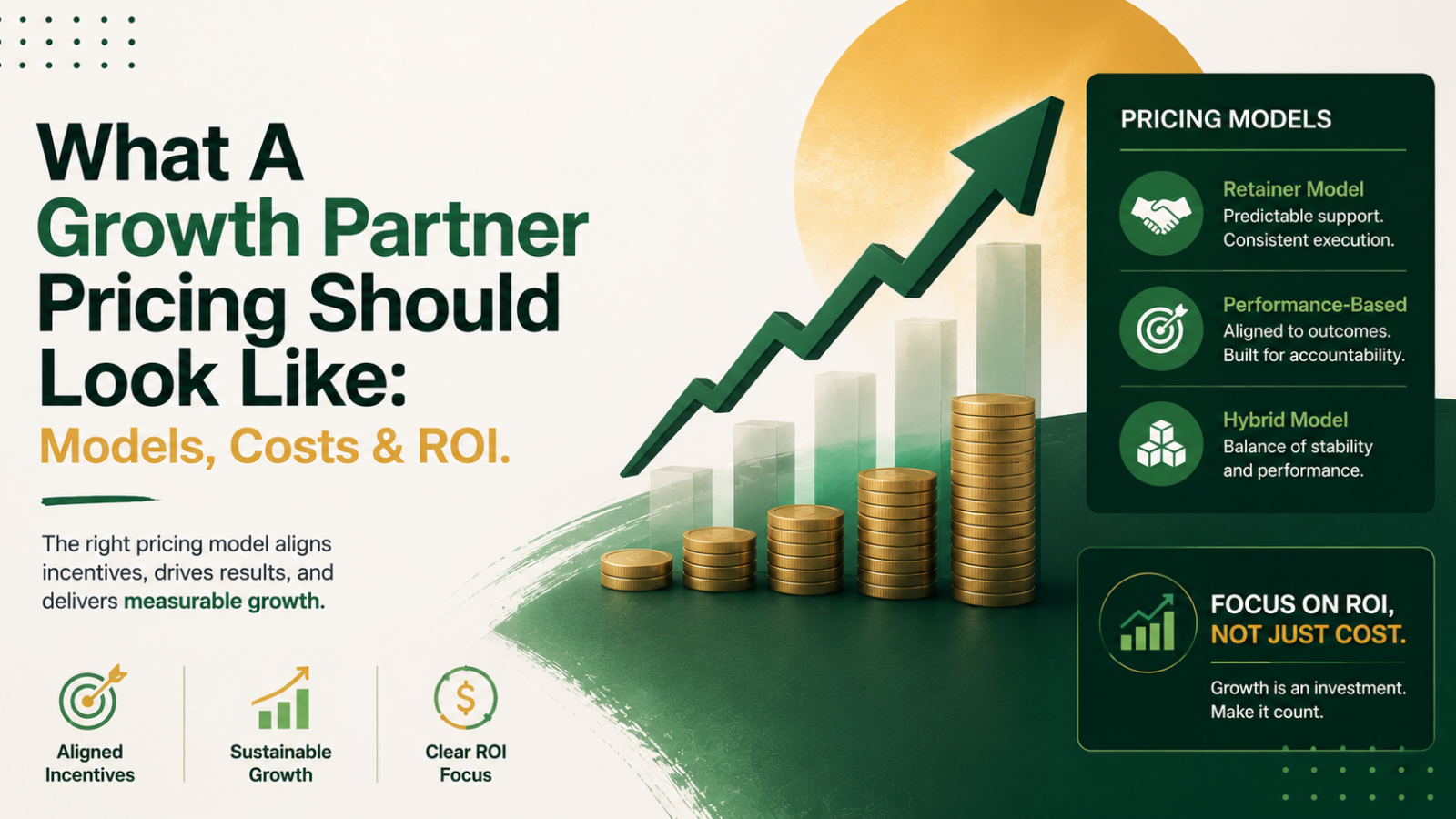
Growth partner pricing typically falls into three models: monthly retainer ($5K-$25K/month depending on scope and startup stage), performance-based (bonuses tied to pipeline or revenue targets), and equity or revenue-share (less common, usually reserved for pre-revenue startups). Most seed-to-Series A startups invest $8K-$15K/month for a full-service growth partner engagement covering attribution, channel management, and CRO.
What you pay matters less than what you get back. This guide gives you the pricing models, realistic cost ranges, and a ROI framework to evaluate whether any growth partner engagement is worth the investment before you sign.
Retainer pricing dominates the market and is usually the right model for seed-to-Series A startups. Performance-based add-ons work well once baseline metrics are established. Equity and revenue-share models are rare and require careful term negotiation. Evaluate every engagement against a simple ROI framework: if the partner can’t show you a plausible path to 3x return on their fee within 12 months, the pricing is wrong regardless of the model.
- How Startup Growth Partner Pricing Works
- The Three Pricing Models: Retainer, Performance & Equity
- What $5K vs $15K vs $25K Per Month Gets You
- How to Calculate Expected ROI from a Growth Partner
- Red Flags in Growth Partner Pricing
- Questions to Ask About Pricing Before Signing
- Common Questions About Growth Partner Pricing
How Startup Growth Partner Pricing Works
Growth partner pricing is not standardised. Unlike legal fees (where hourly rates are common benchmarks) or SaaS software (where per-seat pricing creates comparability), growth partner engagements combine strategy, execution, and infrastructure work in ways that make apples-to-apples comparisons genuinely difficult.
Three factors drive price variation more than any other:
Scope of work. A partner who only manages paid media channels is priced differently from one who also builds your attribution infrastructure, runs CRO experiments, and provides strategic growth leadership. Scope creep in the wrong direction is where most pricing disappointments happen: a founder pays a full-service retainer and gets channel management, or pays a channel management fee and expects strategic direction.
Seniority of the team. A growth partner where a senior strategist leads and owns your account is priced differently from a partner firm where the senior person sells and juniors deliver. The latter is cheaper and usually worth less. Ask directly: who runs the day-to-day on your account, what is their experience level, and how many other accounts do they manage concurrently?
Your stage and the complexity of the problem. A pre-revenue startup with no tracking setup requires different work from a £50K MRR startup with a broken attribution model and an underperforming paid programme. More complex problems require more senior time; that affects price. Partners who quote a flat rate without asking about your current state first are pricing on volume, not value.
At £5K-£8K/month: typically channel management (paid media, SEO), basic reporting, and monthly strategy calls. At £8K-£15K/month: add attribution infrastructure, CRO, and a weekly cadence with a senior strategist. Above £15K/month: full growth programme including measurement build, multi-channel execution, growth experiments, and dedicated senior leadership. Prices are approximate market ranges and vary by region, scope, and firm.
Before asking a growth partner what they charge, know what you need. For help evaluating the full growth partner landscape before committing to a pricing conversation, the evaluation framework covers the questions to ask that reveal scope before price.
The Three Pricing Models: Retainer, Performance & Equity
Each pricing model has different incentive structures. Understanding those incentives is more important than comparing the headline numbers.
Monthly retainer
The dominant model. A fixed monthly fee for a defined scope of work. The founder knows their cost commitment; the partner knows their revenue base. At seed to Series A, this model offers the most predictability and is usually the easiest to budget against runway.
The risk in retainer pricing: the partner’s incentive is to retain the contract rather than to produce results. A well-structured retainer mitigates this with defined deliverables rather than time spent and quarterly performance reviews tied to metrics agreed at the start of the engagement. Without those structures, a retainer can drift into comfortable dependency where the partner feels secure regardless of outcome.
The counter-risk worth noting: purely outcome-based retainers create perverse incentives on the other side. If a partner is only measured on final conversion metrics, they’ll focus on attribution (claiming credit for existing demand) rather than demand creation. Both sides need to agree on metrics that are genuinely growth-attributable.
Performance-based pricing
A performance bonus or fee tied to specific outcomes: pipeline generated, MQLs, closed revenue, or improvement in a defined metric against a baseline. Rarely used as a standalone model; more commonly layered on top of a base retainer.
The appeal is obvious: pay more when results are better. The complexity is in the definition. “Pipeline generated” as a performance metric creates an incentive to optimise for lead volume rather than lead quality. “Closed revenue” is better aligned but introduces a 60-180 day lag before any performance fee is payable, which creates cash flow tension for both sides. “Improvement in trial conversion rate” works well for SaaS; “reduction in CAC” works well for ecommerce; the right performance metric is always the one closest to your actual unit economic constraint.
Growth partner retainer vs performance-based pricing is not an either/or decision. Most sophisticated engagements use a base retainer (which covers cost and provides the partner with stable enough economics to commit senior time) plus a performance kicker (which aligns upside with results). A partner who won’t accept any performance component is telling you something about their confidence in their own output.
Equity or revenue-share models
The rarest model. A growth partner takes equity (typically 0.1-1% depending on stage and scope) or a percentage of revenue generated in lieu of, or in addition to, a cash fee. This model is most common for pre-revenue startups where cash is extremely constrained, or for longer-term embedded partnerships where the partner is effectively a co-founder for growth.
The growth partner revenue share model requires careful structuring. Key questions before agreeing: What revenue base is the share calculated against? New revenue only, or total revenue? What’s the duration of the revenue share agreement? Is there a cash buyout option? How is revenue defined if the product has a usage-based or expansion revenue component?
What $5K vs $15K vs $25K Per Month Gets You
Translating price to scope is the most practically useful thing this guide can do. These are market-range descriptions, not quotes. Actual scope varies by firm, region, and the specific problem being solved.
$5K-$8K/month (£4K-£6K)
At this level you should expect: management of one or two paid channels (Google Ads, Meta, or LinkedIn), basic attribution reporting (GA4 dashboards, monthly channel performance reports), and one strategic touchpoint per month. This is channel management, not a growth partnership. It’s appropriate when you have a specific channel to run and clear KPIs, but you don’t need attribution infrastructure or growth strategy built from scratch.
What you should not expect at this price: senior strategic leadership, attribution infrastructure build, CRO experiments, or a partner who proactively identifies growth problems you haven’t asked about. The economics don’t support it.
If you’re comparing these ranges against what Mowsix charges, our pricing page outlines the current engagement tiers and what each includes.
$8K-$15K/month (£6K-£12K)
The range where a genuine seed-to-Series A growth partner engagement sits. At this level you should expect: a senior strategist as your main point of contact (not a junior account manager), attribution infrastructure setup or audit, multi-channel strategy and execution, monthly reporting against unit economic metrics rather than channel metrics alone, and a weekly or biweekly working session. This is the price point at which the Growth Partner Model as a concept actually operates: measurement-first, system-level thinking, with execution downstream of strategy.
For SaaS-specific growth partner pricing considerations and how the scope differs for product-led versus sales-led SaaS, the vertical guide covers what this price range should include specifically.
$20K-$25K+/month (£15K-£20K+)
Above this level you’re typically getting a full-service embedded growth function: dedicated senior leadership, a team of channel specialists, attribution infrastructure plus ongoing optimisation, growth experiment cadences, weekly reporting, and strategic involvement in product and pricing decisions as they relate to growth. This level makes sense for Series A companies scaling a proven growth motion, or for companies with high ACV where the ROI on senior growth investment is clear.
At this price point you should insist on a named team, documented deliverable commitments, and quarterly performance reviews with defined consequences if targets aren’t met.
How to Calculate Expected ROI from a Growth Partner
The question every founder should be able to answer before signing any growth partner contract: what does the engagement need to produce for the investment to be worth it?
A simple ROI framework built on Unit Economics: see our free unit economics calculator.
Monthly partner cost: $10,000
Target ROI multiple:  3x (minimum acceptable)
Revenue to justify:   $30,000/month in attributed new MRR

At $500 ACV: need 60 new customers/month from partner activity
At $1,000 ACV: need 30 new customers/month
At $2,500 ACV: need 12 new customers/month

Cross-check: is this realistic given current pipeline size and conversion rate?
Three numbers you need to run this calculation for your business:
Your average contract value (ACV) or average order value (AOV). The revenue per customer that any growth programme needs to generate. If ACV is £300/year, a £10K/month growth partner engagement needs to produce roughly 400 new customers per month to hit 3x ROI. That may or may not be plausible at your current stage.
Your LTV:CAC Ratio. If LTV is £1,200 and CAC is currently £400, you have a 3:1 ratio. A growth partner who reduces CAC to £250 without changing LTV improves that ratio to nearly 5:1, which has compounding effects on how aggressively you can invest in acquisition. Conversely, if LTV:CAC is already under 2:1, spending on a growth partner before fixing retention is not the right move.
Your CAC Payback Period. If your current payback period is 18 months and a growth partner can reduce it to 10 months, the cash flow impact is significant regardless of the absolute revenue numbers. A partner who understands CAC Payback Period as a primary output metric is thinking about your business health; one who only tracks revenue uplift is not.
The founders who get the most from growth partner engagements are the ones who arrive with a clear ROI target and hold the partner to it. “We need to produce £X in new attributed MRR within 6 months to justify this investment” is a productive brief. “Help us grow” is not. The specificity of the commercial expectation shapes the quality of the engagement on both sides.
One calculation that most founders skip: the opportunity cost of not hiring in-house. If a £10K/month growth partner delivers the equivalent of a £80K/year Head of Growth plus specialist channel support, the comparison includes the partner fee, the in-house hire total cost (salary plus benefits plus recruiting plus 90-day ramp), plus the risk of a mis-hire. For a detailed comparison of these models, see when to hire a growth partner vs building in-house.
For pricing for ecommerce and fintech engagements where the scope requirements and ROI timelines differ from SaaS, the vertical guide covers what to expect by category.
Want to run the ROI framework above against a real number? Our engagement pricing page shows current tiers, what each includes, and the scope of work at each level. No form required.
Red Flags in Growth Partner Pricing
Pricing structures reveal values and incentives. These are the signals worth watching for before signing.
No defined deliverables, only hours. A retainer priced on hours of time rather than defined outputs means you’re paying for activity rather than outcomes. Ask for a deliverables list; if the partner can’t produce one, the engagement has no accountability structure.
Performance metrics that the partner controls. A performance bonus tied to “content published” or “ads managed” measures effort, not results. Performance pricing should always be tied to outcomes the business cares about: revenue, qualified pipeline, conversion rate improvement, CAC reduction.
A long minimum commitment before any results are shown. Six or twelve month minimums upfront, before any measurement review, are a risk transfer to you. A confident growth partner offers a structured 90-day trial with defined milestones. If the engagement isn’t working at 90 days, you should be able to discuss terms without being locked in.
Equity or revenue-share with no cash floor. Revenue-share-only models (no base retainer) mean the partner is working for deferred payment. That creates incentives to underinvest in work that doesn’t produce measurable short-term revenue, including measurement infrastructure and brand building. A small cash floor keeps the incentives cleaner.
Price that’s much lower than market range. A meaningful growth partner engagement at £2K/month is almost always one of three things: a junior team learning on your budget, a partial-scope engagement that doesn’t include strategy, or a firm with very low senior capacity who will stretch that across too many clients. There is a cost floor below which genuine senior growth partnership is economically unviable. Know where that is for your market before comparing quotes.
No discussion of attribution before pricing is agreed. If a partner quotes you a price without asking how you currently measure growth, what your attribution model is, or what your current CAC looks like, they’re pricing on volume and category, not on the actual work required. Good partners diagnose before quoting.
Questions to Ask About Pricing Before Signing
These questions, asked directly before any contract is signed, surface the information that determines whether a pricing structure is fair and aligned.
What is included in the monthly fee, and what triggers additional charges? Media spend (the actual ad budget) is almost always separate from the management fee. Some partners also charge separately for creative production, tool subscriptions, or attribution software. Know the total cost of engagement, not the headline retainer alone.
Who specifically is on my account, and how many other accounts do they manage? Senior growth strategists running eight or ten concurrent accounts cannot give meaningful attention to any of them. Ask for names and ask about capacity. A senior lead with three to five active accounts is a healthier ratio than one with twelve.
How is performance measured, and against what baseline? If there’s a performance component, the baseline matters as much as the target. A partner who sets their own baseline after starting the engagement has more flexibility to claim attribution for existing momentum. Agree baseline metrics before the engagement starts; better still, baseline them during a measurement audit in week one.
What happens at 90 days if we’re not seeing results? A partner with a genuine accountability structure has a clear answer: specific review criteria, a defined remediation process, and the option to restructure or exit the engagement. Vague answers (“we’d revisit the strategy together”) mean accountability isn’t built into their model.
Is the fee all-inclusive or does it change with scope? Some engagements start at a quoted monthly fee and expand as more channels are added or more work is identified. Understand whether the quoted price is a ceiling or a floor. Growth partner pricing that starts at £8K and routinely reaches £18K by month three through scope additions is misleading in how it’s initially presented.
What does the transition or exit process look like? A growth partner who builds measurement infrastructure, establishes attribution models, and runs your marketing stack should have a clear handover process if the engagement ends. Who owns the accounts? Who holds the platform access? How is institutional knowledge documented and transferred? Partners who make exit difficult are structurally creating dependency that doesn’t serve you.
Common Questions About Growth Partner Pricing
How much does a growth partner cost?
Growth partner pricing typically runs $5K-$25K/month (£4K-£20K) depending on scope, seniority, and startup stage. Most seed-to-Series A startups pay $8K-$15K/month for a full-service engagement covering attribution infrastructure, channel management, and strategic growth leadership. Channel-specific management (paid media only) runs lower; full embedded growth function engagement runs higher. These are market-range estimates; actual quotes depend on scope and firm.
What pricing model does a growth partner use?
Three main models: monthly retainer (fixed fee for defined scope, most common), performance-based (bonus tied to pipeline, revenue, or specific metric improvement, usually layered on a base retainer), and equity or revenue-share (rare, typically for pre-revenue startups or long-term embedded partnerships). Most engagements at seed to Series A use a base retainer with optional performance upside.
What is the difference between retainer and performance-based growth partner pricing?
A retainer gives the founder cost predictability and the partner revenue stability. Performance-based pricing ties fees to results but requires careful metric definition: “pipeline generated” creates different incentives than “closed revenue” or “CAC reduction”. Most sophisticated engagements combine both: a base retainer covers delivery costs, a performance kicker aligns upside with results. Choosing between them depends on how well-defined your success metrics are before the engagement starts.
Is a growth partner worth the investment?
It depends on the ROI case for your specific unit economics. A simple test: if your average customer is worth £1,200 over their lifetime, a £10K/month growth partner engagement needs to produce roughly 25 additional customers per month (at £400 CAC) to hit 3x ROI. If that’s plausible given your current funnel, the investment likely makes sense. If it requires 10x your current conversion rate to work, the pricing doesn’t fit your stage yet.
How does the growth partner revenue share model work?
In a revenue-share arrangement, the growth partner takes a percentage of revenue generated (typically 5-20% of attributed new revenue) in lieu of, or in addition to, a cash fee. The key terms to negotiate: which revenue base the share applies to (new revenue only, or total?), what attribution model determines which revenue counts, the duration of the share agreement, and whether there’s a cash buyout option. Revenue-share-only models without a cash floor tend to underinvest in non-immediately-attributable work like brand and measurement infrastructure.
What should a growth partner engagement include at $10K/month?
At $10K/month you should expect: a senior strategist as primary account lead, attribution infrastructure audit and setup, multi-channel strategy and execution (typically two to three channels), monthly reporting against unit economic metrics rather than channel metrics, and weekly or biweekly working sessions. If the partner at this price point can only offer channel management and monthly reporting against impression and click data, the pricing is not commensurate with the output.
Want to know if a growth partner engagement makes sense for your stage?
Start with our pricing page to see current engagement tiers and scope. Then book a free 45-minute audit. We review your unit economics and attribution setup and give you an honest view of whether now is the right moment and what the engagement should cost. Written summary included.
Book your free audit →Sources: Pricing ranges are approximate market estimates based on publicly available information and general market observation; actual quotes vary significantly by firm, scope, region, and startup stage. Internal Mowsix observations from engagement scoping conversations conducted since 2024.
Numbers most founders never see.
One email every other Friday. The CAC, ROAS, and pipeline benchmarks behind real growth — pulled from the work we run for actual startups.
Unsubscribe in one click. We don't share your email.