
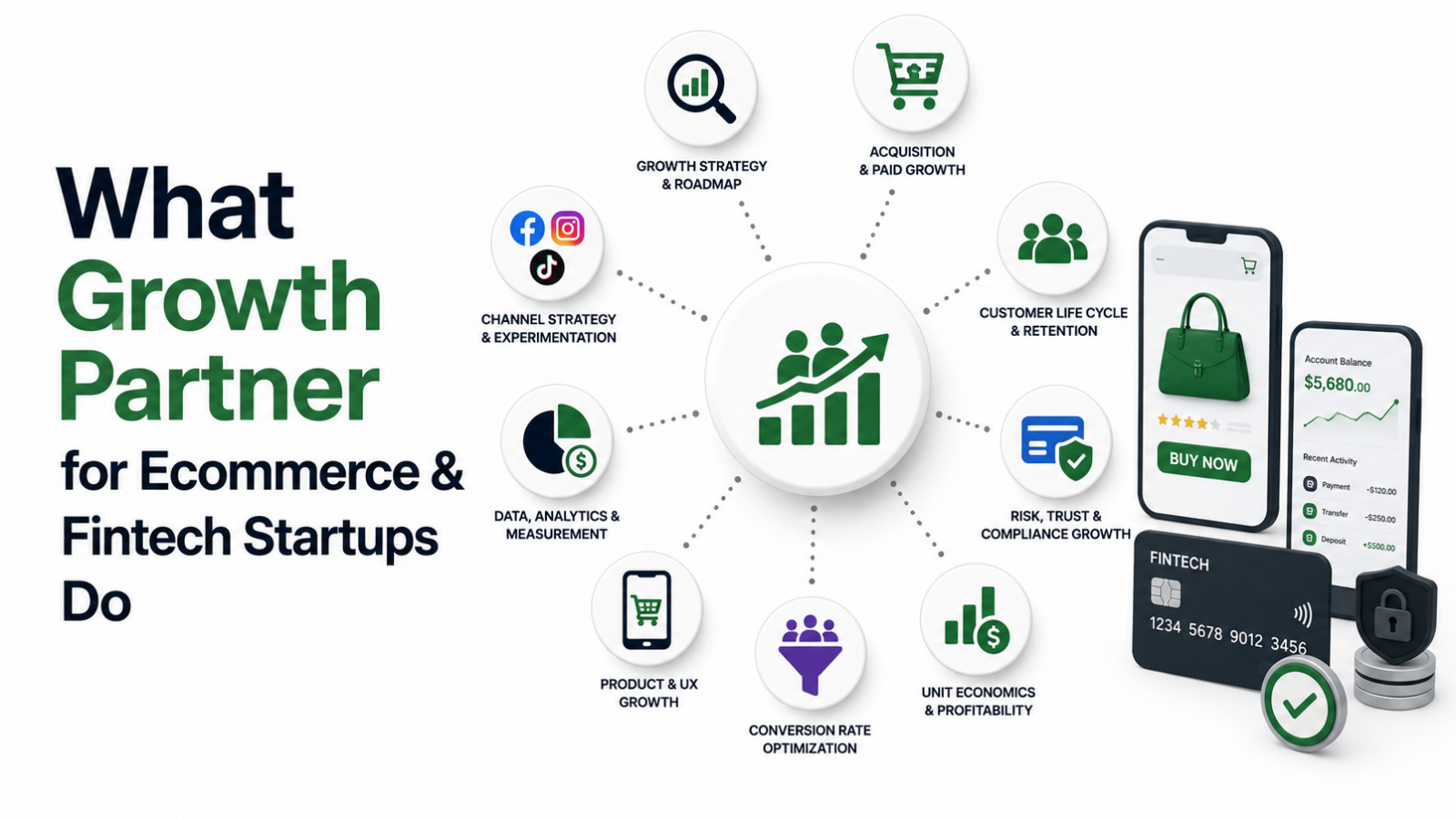
Ecommerce and fintech startups face distinct growth challenges that traditional agencies aren’t equipped to solve. Ecommerce brands routinely waste significant ad spend on last-click attribution models that overcredit the final touchpoint and undercredit the channels that actually drove the sale. Fintech startups operate in a compliance-heavy environment where customer journeys span weeks across regulated touchpoints. A vertical-specialised growth partner builds clean measurement infrastructure for both, then optimizes spend against real revenue data.
The result in both cases: better decisions about where to spend, which channels to scale, and which to cut.
Ecommerce and fintech brands share a data problem, not a traffic problem. Last-click attribution blindness in ecommerce and compliance-locked measurement in fintech both produce the same symptom: ad spend that can’t be confidently attributed to revenue. A growth partner who specialises in your vertical fixes measurement first, then scales spend. Generalist agencies almost never do this.
- Why Ecommerce and Fintech Share the Same Growth Problem
- The Ecommerce Attribution Problem: Last-Click and the 47% Waste
- How a Growth Partner Rebuilds Ecommerce Measurement Infrastructure
- Fintech Growth: Compliance, Long Sales Cycles & Multi-Touch Attribution
- Channel Strategies That Work for Each Vertical
- Choosing a Growth Partner Who Understands Your Vertical
- Common Questions About Growth Partners for Ecommerce and Fintech
Why Ecommerce and Fintech Share the Same Growth Problem
At first glance, an ecommerce brand selling skincare products and a fintech startup offering SME lending have nothing in common. Different products, different sales cycles, different regulatory environments. But they share a structural growth problem that looks the same from the outside: ad spend that produces traffic and costs money without a reliable line back to revenue.
In ecommerce, the problem is attribution fragmentation. A customer sees a Facebook ad, ignores it, later searches for a review on Google, reads a blog post, clicks a retargeting ad on Instagram, and finally converts via a direct website visit. The last-click model attributes the entire sale to the direct visit. Facebook, Google, and Instagram all get partial credit in their own dashboards. The real picture (which channel started the journey, which nurtured it, which closed it) is invisible.
In fintech, the problem is measurement friction. Regulatory constraints limit what data can be tracked at which touchpoints. Long consideration periods (weeks or months for a business loan, a payment processor switch, or an investment product) make standard 7-day attribution windows meaningless. And compliance requirements around financial product advertising restrict the ad formats and tracking mechanisms that work freely in other categories.
Both problems have the same solution: a growth partner who understands the specific measurement architecture that the vertical requires, builds it before touching spend, and then optimises channels against reliable data rather than misleading dashboards.
The Ecommerce Attribution Problem: Last-Click and the 47% Waste
Last-click attribution is the default for most ecommerce businesses on Google Analytics 4 out of the box. It assigns 100% of conversion credit to the final click before purchase. For a customer who discovered a brand through a YouTube ad, engaged through email, and converted via a Google Shopping click, the Shopping click gets all the credit and the YouTube ad gets none.
The consequence: ecommerce brands systematically underfund the channels that create demand and overfund the channels that capture it. Paid search and retargeting look highly efficient in last-click models because they sit at the end of the journey. Upper-funnel channels like paid social and content look expensive because they sit at the start. Budgets shift toward the bottom of the funnel; demand creation dries up; eventually retargeting audiences shrink because fewer new customers are entering the top.
Industry estimates put ad spend waste attributable to attribution errors in the range of 40-50% for ecommerce advertisers running cross-channel programmes. The range varies by category, spend level, and channel mix; the point is not the precise figure but the direction. Decisions made on last-click data produce structurally wrong channel mix decisions at scale.
Last-click attribution doesn’t just misattribute credit. It actively damages growth by creating a feedback loop: channels that look efficient get more budget, channels that look expensive get cut, the demand-creation layer erodes, and the channels that “work” gradually become less effective as audience pools shrink. The fix is not a better reporting dashboard. It’s a different attribution model with better underlying data.
The specific gaps that create attribution errors in ecommerce:
iOS 14+ signal loss. Apple’s App Tracking Transparency framework (introduced in iOS 14.5) significantly reduced the signal available to Facebook and Instagram advertisers for purchase attribution. Brands running meaningful Meta spend often see tracked purchases in Meta’s interface that are far lower than actual Meta-driven purchases in their Shopify or WooCommerce backend.
Cross-device journeys. A customer who browses on mobile and purchases on desktop appears as two unconnected sessions in most analytics setups. Revenue gets attributed to the desktop session; the mobile touchpoints that drove discovery are invisible.
Browser cookie expiry and ad blockers. Standard browser-side tracking misses conversions from users with ad blockers or short cookie windows. Server-side tracking recovers a meaningful proportion of these missed events.
How a Growth Partner Rebuilds Ecommerce Measurement Infrastructure
A measurement-first ecommerce growth partner, like Mowsix, audits the attribution stack before recommending any channel changes. The audit typically finds three to five significant tracking gaps within the first two weeks. Fixing them changes the data picture enough that previous channel decisions need to be revisited.
The measurement rebuild for ecommerce typically covers:
Server-side tracking implementation. Moving key conversion events (purchases, add-to-cart, checkout initiation) from browser-side to server-side eliminates the signal loss from ad blockers and cookie expiry. Google Tag Manager’s server-side container is the standard deployment vehicle. This single change often recovers 15-30% of previously untracked conversions.
Meta Conversions API (CAPI) integration. CAPI sends purchase data directly from the server to Meta rather than relying on the browser pixel. For ecommerce brands with significant Meta spend, CAPI integration partially recovers the signal lost to iOS 14+ restrictions and produces more accurate Meta attribution.
Cross-device user stitching. Using email-based user identification (logged-in sessions, email capture at checkout) to connect mobile-browse and desktop-purchase events in a unified customer profile. Requires a Customer Data Platform or similar infrastructure; the approach varies by platform and scale.
Multi-Touch Attribution modelling. Once server-side tracking is in place and conversion data is reliable, a growth partner applies a Multi-Touch Attribution model that distributes conversion credit across touchpoints rather than assigning it to the last click. Data-driven attribution (available in GA4 for accounts with sufficient volume) or linear attribution models both produce a more accurate channel picture than last-click.
Tools like Cometly and Singular specialise in cross-channel attribution for performance advertisers. Cometly focuses specifically on ad attribution recovery post-iOS 14, connecting ad spend to actual revenue through server-to-server data transfer. Singular aggregates attribution data across channels into a unified marketing analytics layer. Both are tools that a serious ecommerce growth partner should be familiar with; which one (if either) fits depends on spend volume, channel mix, and existing tech stack.
For a full technical breakdown, see attribution models for ecommerce and fintech.
Fintech Growth: Compliance, Long Sales Cycles & Multi-Touch Attribution
Fintech marketing measurement is harder than ecommerce measurement for reasons that are structural rather than technical. The regulatory environment shapes what can be tracked, what can be retargeted, and how long attribution windows need to be.
Three compliance-driven constraints that fintech growth teams face:
Financial product advertising restrictions. Google, Meta, and TikTok all impose additional requirements on advertisers promoting financial products: lending, investment products, payment services, and insurance. In regulated markets including the UK (FCA-regulated), these requirements include advertiser certification, restricted ad formats, and mandatory risk disclaimers. These restrictions limit the tracking mechanisms available and often restrict retargeting to audiences who’ve already engaged with the brand.
Data handling and consent requirements. GDPR in the UK and EU creates consent requirements that reduce the trackable user pool. A fintech user who declines analytics cookies is invisible to standard GA4 tracking. Server-side tracking with consent mode integration partially recovers aggregate data while respecting individual consent choices; it’s more complex to implement than standard setups.
Long and multi-touch sales cycles. A business owner considering switching payment processors, taking a business loan, or adopting a new banking platform may take 30, 60, or 90 days from first awareness to conversion. Standard 7-day or 28-day attribution windows miss most of this journey. The marketing touchpoints that created awareness and built trust during a 90-day consideration period get no credit in standard attribution setups.
Fintech startups we’ve audited consistently face the same gap: their CRM shows customers who came from organic search and content, but their attribution model credits paid retargeting because it was the last click. The content investment that took six months to build looks like it produces no revenue. A proper multi-touch model with a 90-day window changes that picture significantly.
The measurement approach for fintech differs from ecommerce primarily in attribution window length and data source integration. A fintech growth partner needs to connect CRM conversion data (which captures the actual account opening or loan approval) back through to the marketing touchpoints that preceded it, across a window that matches the actual sales cycle. This requires CRM integration, UTM parameter persistence through to conversion, and a Multi-Touch Attribution model with a window of 60-90 days rather than the standard 7 or 28.
Pattern, the ecommerce and marketplace acceleration company, has documented similar measurement challenges in consumer product categories with long consideration cycles. The principle applies equally in fintech: if the attribution window is shorter than the sales cycle, the channels driving early-journey engagement will be systematically undercredited and underfunded.
Channel Strategies That Work for Each Vertical
Once measurement is reliable, channel strategy diverges significantly between ecommerce and fintech. The right channel mix depends on the sales cycle, the unit economics, and the competitive landscape of each vertical.
Ecommerce channel priorities
Google Shopping and Performance Max. For ecommerce brands with a product catalogue, Shopping campaigns remain one of the highest-intent acquisition channels available. They capture buyers who are actively comparing products and prices. A growth partner managing Shopping campaigns should have feed optimization, bidding strategy, and brand vs non-brand separation as baseline competencies.
Paid social for demand creation. Meta (Facebook and Instagram) and TikTok work differently from Shopping: they interrupt rather than capture. The job is creating demand among audiences who aren’t actively searching. Creative quality, audience segmentation, and frequency management matter more than bid strategy. An ecommerce growth partner who treats paid social like paid search will underperform.
Email and retention marketing. Repeat purchase rate is a critical ecommerce unit economics driver. A growth partner focused only on acquisition while ignoring email and SMS retention is leaving significant revenue on the table. For most ecommerce brands, the customer who buys twice is worth three to five times the customer who buys once. Retention programmes should run in parallel with acquisition from the start.
Audience-based segmentation, where different customer cohorts receive different creative and offers based on purchase history and behaviour, is where ecommerce growth programmes compound over time. A partner with sophisticated CRM and email segmentation capability delivers more long-term value than one who focuses only on paid acquisition.
Fintech channel priorities
SEO and content for long-cycle consideration. Fintech buyers research heavily before converting. A business owner evaluating a new payment processor will read comparison articles, case studies, and reviews before requesting a demo. SEO content that answers decision-stage questions (pricing comparisons, integration guides, compliance explainers) captures buyers at the exact moment of consideration. This channel compounds over 6-18 months; it requires patience that most paid-only agencies don’t build into their growth model.
LinkedIn for B2B fintech acquisition. For fintech products targeting business decision-makers (CFOs, finance directors, operations leads), LinkedIn’s targeting by company size, industry, and job title is difficult to replicate elsewhere. The CPMs are high; the qualification is strong. A growth partner who understands LinkedIn campaign structure, lead gen form optimization, and the follow-up sequence required to convert a LinkedIn lead produces better results than one who applies Facebook Ads playbooks to the platform.
Partnership and referral channels. Fintech products targeting SMEs often convert better through referral from accountants, bookkeepers, or industry associations than through direct advertising. A growth partner who can identify and activate referral partners as a channel often produces lower CAC than pure paid acquisition in fintech categories.
Choosing a Growth Partner Who Understands Your Vertical
Vertical expertise is claimed easily and demonstrated rarely. Here’s how to test it.
For ecommerce growth partners: Ask them to describe their attribution audit process for a new ecommerce client. They should describe server-side tracking, CAPI setup, and a multi-touch attribution model without prompting. Ask specifically about iOS 14+ signal recovery and how they reconcile Meta-reported conversions against Shopify or WooCommerce actual revenue. If those concepts are unfamiliar, the partner doesn’t have ecommerce measurement depth.
Also ask for a reference from an ecommerce brand at your revenue range (£500K-£5M). The difference between growing a £100K revenue brand and a £3M revenue brand is significant: margin pressure, catalogue complexity, and the channels that make economic sense at each scale all differ.
For fintech growth partners: Ask how they handle attribution for a 90-day sales cycle. Ask how they’ve navigated FCA advertising requirements (or equivalent in your market) in previous engagements. Ask what their retention content strategy looks like for a fintech product in the consideration phase. General growth agency answers to these questions reveal very quickly whether the partner has genuine fintech experience or is learning on your budget.
For a comprehensive evaluation framework that applies across verticals, see choosing a vertical-specialised growth partner.
One structural difference between ecommerce and fintech engagements that affects how you should think about partner selection: ecommerce growth programmes can show measurable results faster (4-8 weeks for paid channel changes to show in revenue data) while fintech programmes often require 12+ weeks before content and SEO investments produce measurable attribution. Choose a partner whose commercial model allows for the right timeline. A partner on a 90-day break clause won’t prioritise a 12-month SEO programme for fintech.
For an overview of how engagement structures and pricing for ecommerce and fintech engagements differ by vertical, the pricing guide covers typical retainer ranges and what scope each should include.
Common Questions About Growth Partners for Ecommerce and Fintech
What does a growth partner do for an ecommerce brand?
An ecommerce growth partner audits and rebuilds attribution infrastructure first, then optimises channel mix against reliable revenue data. That typically means server-side tracking setup, CAPI integration, multi-touch attribution modelling, and reconciling ad platform data against actual backend revenue. Channel work (Shopping, paid social, email) follows once the measurement layer is trustworthy. Partners who skip straight to channel work are optimising against misleading data.
What does a growth partner do for a fintech startup?
A fintech growth partner builds a measurement architecture that handles long sales cycles, consent requirements, and CRM-to-marketing attribution. They connect the actual conversion event (account opening, loan approval, subscription start) back through 60-90 days of marketing touchpoints. Channel strategy for fintech typically combines SEO and content for long-cycle consideration with LinkedIn for B2B acquisition and referral or partnership activation for lower-CAC distribution.
What is the difference between an ecommerce growth partner and an ecommerce agency?
An ecommerce agency executes channel campaigns. An ecommerce growth partner fixes the measurement layer, models unit economics (contribution margin per order, LTV, repeat purchase rate), and then optimises channel mix based on which channels produce profitable customers at scale. The practical test: ask what happens in the first 30 days. An agency launches campaigns; a growth partner audits attribution.
What are the main fintech marketing attribution challenges?
Three main challenges: regulatory restrictions on ad formats and tracking (which limit retargeting options and require consent mode), long sales cycles that exceed standard attribution windows (90+ days versus the standard 7-28 day window), and the gap between marketing platform data and CRM-recorded conversions. A growth partner with fintech experience builds measurement architecture that accounts for all three rather than defaulting to GA4’s standard setup.
How do I choose a growth partner for ecommerce?
Test attribution knowledge first. Ask how they handle iOS 14+ signal loss, how they reconcile Meta-reported versus actual revenue, and what their server-side tracking deployment process looks like. Press for a reference from an ecommerce brand at your revenue range. A partner who can answer those questions specifically has done the work. One who answers vaguely is learning on your budget.
Should an ecommerce brand hire a growth partner or an in-house team?
At £500K-£5M revenue, a growth partner typically delivers more measurement depth and channel expertise than a single in-house hire at comparable cost. The crossover point where building in-house makes more economic sense is usually when a single channel (say, Meta ads or email) is proven and needs dedicated full-time management to scale. Until then, a partner with a team of specialists across attribution, paid media, and CRO produces better outcomes than one person stretched across all three.
Spending on ads you can’t reliably attribute to revenue?
Free 45-minute audit. We’ll review your attribution setup, reconcile your ad platform data against actual revenue, and tell you where the measurement gaps are. Written report included, whether you work with us or not.
Sources: Attribution waste estimates are industry-range figures and vary significantly by advertiser category, channel mix, and measurement maturity. Tool references (Cometly, Singular, Google Analytics 4, Google Tag Manager, Pattern) are factual descriptions based on publicly available product information; inclusion is not a commercial endorsement. iOS 14+ signal loss impact is well-documented by Meta and independent measurement researchers. Internal Mowsix observations from ecommerce and fintech audits conducted since 2024.
Numbers most founders never see.
One email every other Friday. The CAC, ROAS, and pipeline benchmarks behind real growth — pulled from the work we run for actual startups.
Unsubscribe in one click. We don't share your email.