
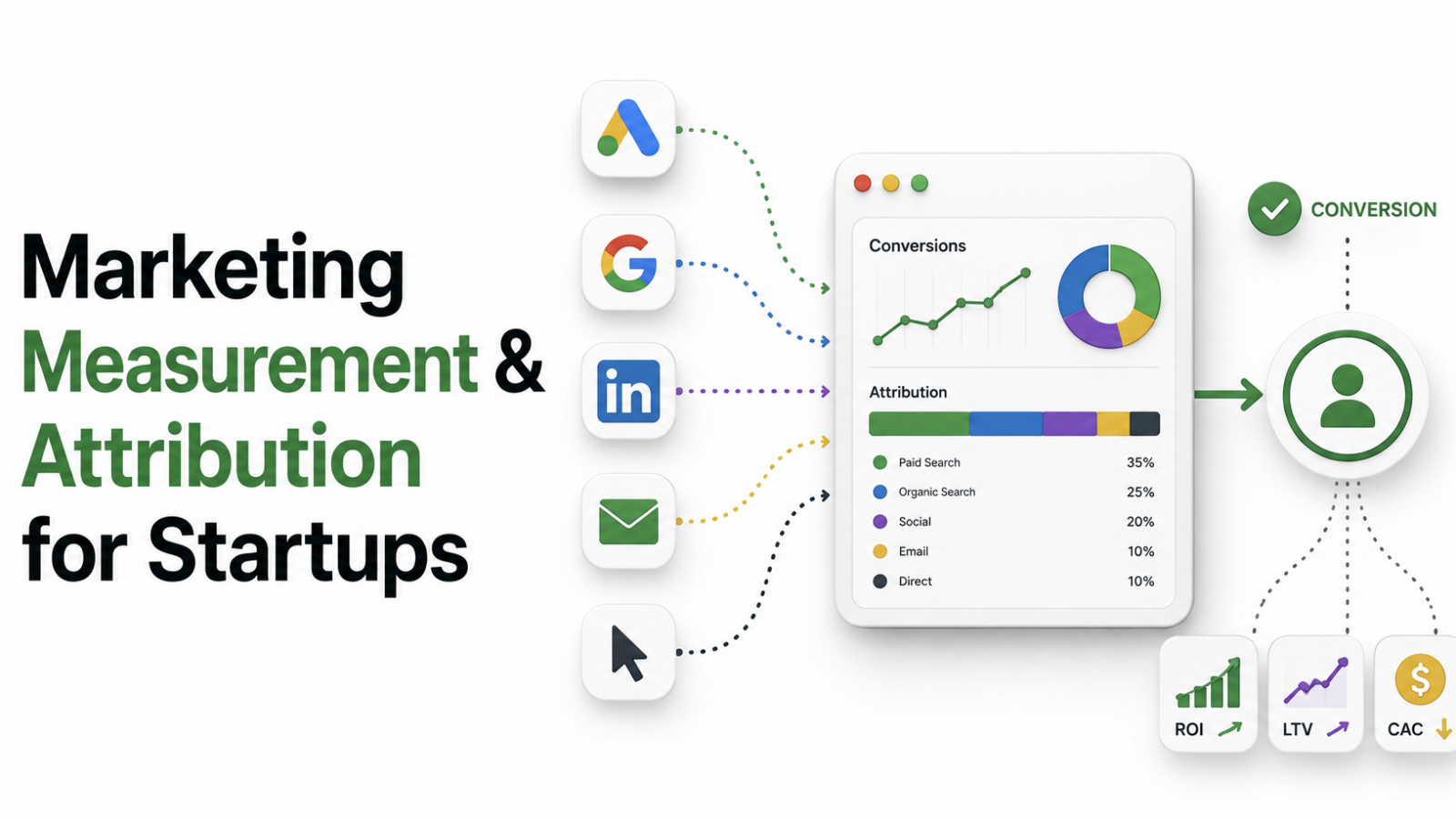
Marketing measurement for startups starts with clean tracking infrastructure. Not a dashboard. Before any attribution model can work, you need server-side tagging, unified event tracking across website and product, and CRM-integrated conversion data. From there, choose an attribution model that matches your sales cycle: single-touch for short cycles, multi-touch data-driven for B2B SaaS. The goal is channel-level ROI you can act on, not vanity dashboards.
What follows is the full startup measurement playbook: how to build the infrastructure, choose the right model, run a weekly metrics review, and report numbers that mean something to investors.
Broken measurement is a growth strategy problem, not a reporting problem. Most startups build dashboards before fixing the data underneath them. The correct order: fix tracking infrastructure, define your attribution model, baseline your Unit Economics, then report. Skip a step and every channel decision downstream is wrong.
- Why Most Startup Marketing Data Is Broken
- Step 1: Build Clean Tracking Infrastructure (Before You Attribute Anything)
- Server-Side Tagging vs Client-Side: What Startups Need to Know
- Choosing the Right Attribution Model for Your Sales Cycle
- The Measurement Stack: GA4, GTM, CRM, and Attribution Tools
- From Data to Decision: Building a Weekly Growth Metrics Review
- The Metrics That Actually Matter for Startup Investors
- Common Questions About Marketing Measurement for Startups
Why Most Startup Marketing Data Is Broken
Startup founders routinely make channel investment decisions on data that misrepresents reality. Three failure modes account for most of the broken measurement we see:
Last-click attribution. Google Analytics 4 out of the box assigns 100% of conversion credit to the last touchpoint before conversion. A customer who found you through a podcast mention, researched you on Google, clicked a retargeting ad, then signed up via a direct visit gets counted as a direct visit. The podcast, the Google result, and the retargeting ad are invisible. Every channel investment decision made from that data is distorted.
Platform self-attribution. Every major ad platform (Meta, Google, LinkedIn, TikTok) attributes conversions to itself using its own measurement window and methodology. A customer who sees a Meta ad and a Google ad before converting will appear as a conversion in both platforms’ dashboards. Add them up and you have more conversions than customers. Founders who optimise based on platform-reported ROAS are making decisions on numbers that are mathematically impossible to be simultaneously correct.
Missing mid-funnel events. Most GA4 setups track pageviews and final conversions. The activation events in between (account created, feature activated, data source connected, demo booked, pricing page viewed) are untracked. Without those events, you can’t see where users drop out, which channels produce users who actually activate, or which acquisition sources generate your best customers.
The most common finding in startup measurement audits: a founder who believes paid search is their highest-performing channel because it shows the lowest CPA in GA4, while organic content and referral channels that actually initiate most customer journeys get no credit. When we rebuild attribution with a multi-touch model, the channel rankings almost always change. So do the budgets.
The startup marketing measurement framework that actually works starts with acknowledging that the data problem is structural, not cosmetic. Building a better dashboard on top of broken tracking produces more confident wrong decisions. The fix has to start at the infrastructure layer.
Step 1: Build Clean Tracking Infrastructure (Before You Attribute Anything)
The measurement audit should happen before any attribution model is chosen. You can’t build a reliable multi-touch attribution model on unreliable underlying event data. The infrastructure layer has three components:
Unified event taxonomy. Define every meaningful user action across your website and product and give each event a consistent name. “trial_started” on the website should match “trial_started” in your product analytics tool. A customer journey that spans both environments needs consistent event naming to be stitched together. Most startups have different naming conventions in GA4, their product analytics tool, and their CRM. That inconsistency makes cross-system attribution impossible.
UTM parameter discipline. Every paid link, every email, every social post that drives traffic should carry UTM parameters: source, medium, campaign, and where relevant, content and term. UTMs are the thread that connects a marketing touchpoint to a downstream conversion. A click without a UTM is an unattributed touchpoint. Most startups have inconsistent UTM discipline: some campaigns tagged, others not, with no validation process to catch missing tags before campaigns go live.
CRM integration with marketing data. The conversion event that matters (a customer signing a contract, opening an account, starting a paid subscription) typically happens in the CRM or payment system, not in GA4. Connecting those conversion events back to the marketing touchpoints that preceded them requires either native integration (most CRMs have GA4 connectors) or a deliberate data pipeline. Without this connection, you know which channels produce leads. You don’t know which channels produce customers.
Before choosing any attribution model, confirm: (1) every meaningful event is tracked with consistent naming, (2) all paid traffic carries UTM parameters and they’re validated before launch, (3) the final conversion event in your CRM or payment system is connected to marketing data, (4) you can identify individual users across sessions (logged-in states or email capture). If any of these are missing, fix them before building attribution models.
Server-Side Tagging vs Client-Side: What Startups Need to Know
Most startups begin with client-side tracking: a JavaScript tag fires in the user’s browser when an event happens and sends data to Google Analytics, Meta, or another platform. It’s simple to set up. It’s also becoming less reliable.
Three forces erode client-side tracking accuracy:
Ad blockers. A significant proportion of startup target audiences (developers, product managers, technical founders) use ad blockers that block analytics scripts. Events from those users never fire.
iOS privacy changes. Apple’s Intelligent Tracking Prevention and App Tracking Transparency frameworks limit the cookie lifetime and tracking capability available to browser-side scripts. Attribution windows shrink; cross-site tracking breaks.
Cookie consent. GDPR consent requirements mean that users who decline analytics cookies generate no tracking data. In regulated markets with high decline rates, you can lose 20-40% of event data to consent opt-outs.
Server-side tagging moves the event processing from the user’s browser to your own server. When a user converts, your server captures the event and forwards it directly to your analytics and advertising platforms via server-to-server API calls. Ad blockers and browser-side restrictions don’t apply. The conversion data reaches the platform regardless of browser settings.
Google Tag Manager’s server-side container is the standard deployment vehicle for this setup. It requires a cloud server instance (typically Google Cloud Run or similar) and more technical configuration than client-side GTM. For most startups at seed to Series A, the engineering time required is 1-3 days. The return in data accuracy justifies that investment once you’re spending meaningfully on paid acquisition.
For conversion events worth significant revenue per customer, server-side tracking is close to non-negotiable. A B2B SaaS startup with a £5,000 ACV can’t afford to miss 30% of its conversions in its attribution data; the channel investment decisions made on incomplete data are too consequential.
Client-side (browser JS):
  + Easy to implement
  + No server infrastructure required
  - Blocked by ad blockers (~15-30% of users)
  - Affected by cookie restrictions (ITP, GDPR)
  - Loses data on consent decline

Server-side (GTM server container):
  + Unaffected by ad blockers
  + Full conversion data regardless of browser
  + Supports Meta CAPI, Google Enhanced Conversions
  - Requires cloud server instance
  - 1-3 days engineering setup
  - Small ongoing cloud cost (~$50-100/month)
Choosing the Right Attribution Model for Your Sales Cycle
The right attribution model for your startup depends on one thing more than any other: how long it takes someone to become a customer from first contact. Sales cycle length determines how many touchpoints exist before conversion and therefore how much complexity the attribution model needs to handle.
Short cycle (under 7 days). If most customers convert within a week of their first visit, single-touch attribution, either first-touch (credits the channel that initiated the journey) or last-touch (credits the final click), captures most of the relevant information. Multi-touch models add complexity without adding insight when the journey is short. First-touch attribution is usually more strategically useful for short-cycle products: it tells you which channels start journeys, which is the most controllable variable for acquisition investment.
Medium cycle (7-30 days). Linear attribution (equal credit to all touchpoints) or time-decay attribution (more credit to touchpoints closer to conversion) both work here. Linear is easier to explain to stakeholders; time-decay better reflects the reality that the consideration-phase touchpoints closest to conversion are usually more influential.
Long cycle (30+ days, typical for B2B SaaS). Data-driven Multi-Touch Attribution, where an algorithm distributes credit across all touchpoints based on their observed correlation with conversion, is the most accurate model for complex, multi-touchpoint B2B journeys. It requires volume to work properly (GA4’s data-driven model needs at least 400 conversions in 30 days to activate), but produces the most defensible channel ROI picture.
For product-led SaaS with a short trial-to-paid cycle (under 14 days): first-touch or linear attribution in GA4. For sales-led B2B SaaS with a 30-90 day cycle: data-driven multi-touch attribution, with CRM integration to track through to closed revenue. For pre-volume startups (under 400 conversions/month): linear or position-based attribution as a proxy until data-driven becomes available.
A common mistake at early stage: choosing a sophisticated attribution model before having enough conversion volume for it to produce reliable results. If you have 30 conversions per month, data-driven attribution will produce unstable, noisy outputs. Start with linear; switch to data-driven when volume supports it. The startup attribution model should match the data volume, not the theoretical sales cycle alone.
For a practical walkthrough of how to implement attribution in each vertical, the guides for SaaS-specific attribution and ecommerce and fintech attribution cover the specific toolchain and model choices for each.
The Measurement Stack: GA4, GTM, CRM, and Attribution Tools
Building a marketing measurement framework for an early-stage startup requires five layers. Each layer has a job; skipping one creates a gap that makes the layers above it unreliable.
Layer 1: Tag management. Google Tag Manager. GTM is the deployment layer for all tracking tags. It lets you add, modify, and remove tracking scripts without code deployments. Every startup should be running GTM (not hard-coded analytics tags) because it creates the flexibility to iterate on tracking without engineering sprints. Use the server-side container for conversion events; use the standard browser container for pageview and engagement tracking where signal loss is acceptable.
Layer 2: Web and app analytics. Google Analytics 4. GA4 is the primary event data store for most startups. Knowing how to set up GA4 for a startup correctly means: creating a server-side data stream alongside the standard web stream, configuring custom events for your specific activation milestones, setting up conversions (not merely goals), enabling Google Signals for cross-device tracking, and connecting to BigQuery for raw data access. Out-of-the-box GA4 with auto-collected events only gives you traffic data; properly configured GA4 gives you a behavioural event database.
Layer 3: Product analytics. Amplitude or Mixpanel. For SaaS products with meaningful in-app behaviour, a dedicated product analytics tool handles the in-product event stream more effectively than GA4. Amplitude’s funnel analysis, retention curves, and user cohort tools are purpose-built for product-led growth analysis. GA4 handles the marketing-side events; the product analytics tool handles what happens after signup. The two systems need consistent user identification to stitch journeys together.
Layer 4: CRM integration. HubSpot, Salesforce, or equivalent. The CRM holds the ground truth of who became a paying customer and when. Marketing attribution that doesn’t connect through to CRM-recorded revenue produces lead counts, not revenue attribution. UTM parameters need to persist from first click through to the CRM record. This is the technical link that most startups are missing.
Layer 5: Multi-touch attribution and revenue analytics. HockeyStack connects marketing touchpoints, CRM data, and product usage into a unified revenue analytics view, purpose-built for B2B SaaS. Cometly specialises in ad attribution recovery for performance advertisers, particularly post-iOS 14 signal loss. Singular aggregates attribution data across mobile and web channels into a unified marketing measurement layer. Which tool fits depends on your category: B2B SaaS with a sales motion (HockeyStack), DTC ecommerce or app-heavy businesses with significant Meta/Apple spend (Cometly, Singular), or omnichannel B2B (combination).
For a complete overview of tools and infrastructure for your measurement stack beyond attribution, the growth stack guide covers the full toolchain including product analytics, CRM, and data warehouse options.
From Data to Decision: Building a Weekly Growth Metrics Review
The point of measurement infrastructure is faster, better decisions. A weekly growth metrics review is where the data becomes action. Without a structured review cadence, measurement infrastructure produces reports that get read and forgotten rather than decisions that get made.
A weekly growth metrics review for a seed-to-Series A startup should cover four things and nothing else:
1. Channel performance against CAC targets. For each active acquisition channel: how many attributed conversions this week, at what attributed CAC, versus the target CAC you set at the start of the quarter. Channels above target CAC get reviewed for optimisation or budget reduction. Channels below target CAC get reviewed for budget increase. This is the primary weekly decision loop.
2. Funnel conversion rates at each stage. Visit-to-signup, signup-to-activation, activation-to-paid (or activation-to-demo for SLG). Which stage changed week-on-week? If visit-to-signup dropped, a landing page or traffic quality issue deserves investigation. If activation-to-paid dropped, an onboarding or product issue is more likely. Attribution data without funnel data tells you where customers come from; funnel data tells you where they go once they arrive.
3. Pipeline Velocity (for sales-led products). Number of active deals multiplied by average deal size multiplied by win rate, divided by average sales cycle length. Pipeline Velocity tells you whether revenue output is increasing or decreasing independent of new deal volume. A startup that adds 20 new deals but has slowing Pipeline Velocity has a problem that more top-of-funnel marketing won’t fix.
4. One experiment result or hypothesis. Every week, one growth experiment should be reporting results or one new hypothesis should be queued for next week’s test. The review is the cadence that forces experiment discipline. Without it, experiments run without deadlines and decisions get deferred.
The review should take 30-45 minutes. If it takes longer, the dashboard has too many metrics. Metrics not connected to a decision this week don’t belong in the weekly review; they belong in a monthly or quarterly report.
Once measurement is working and channels are optimised against clean data, the next question is which channels to invest in further. See the guide on optimizing channels against clean measurement data for channel-specific strategies.
The Metrics That Actually Matter for Startup Investors
Investor scrutiny is the ultimate measurement accountability test. A founder who can’t explain the relationship between their marketing spend and their revenue trajectory at a board meeting has a measurement problem, not a communication problem.
The Unit Economics metrics that investors focus on at seed to Series A:
CAC Payback Period. How many months of gross profit it takes to recover the cost of acquiring a customer. Under 12 months is considered healthy for most SaaS businesses at Series A; under 18 months is acceptable. CAC Payback Period is a cash flow health metric: shorter payback means the business can fund growth from its own revenue more quickly. A founder who can show improving payback period over four quarters has a compelling growth efficiency narrative.
LTV:CAC Ratio. Lifetime customer value divided by acquisition cost. A ratio of 3:1 or above is the conventional threshold for a sustainable SaaS acquisition model. The numerator (LTV) requires reliable churn and expansion revenue data; the denominator (CAC) requires reliable attribution. Both require measurement infrastructure to produce defensible numbers. Investors who ask “what’s your LTV:CAC?” are testing both the ratio and the quality of the measurement behind it.
Net Revenue Retention (NRR). Revenue retained from existing customers after accounting for churn and expansion. Expressed as a percentage. NRR above 100% means existing customers are growing faster than you’re losing them. This metric requires reliable subscription or revenue data tied to individual customers, which means CRM and payment system data integration. NRR is increasingly the metric investors weigh most heavily at Series A, because it indicates whether the product compounds or decays.
Attributed growth by channel. Which percentage of new MRR came from which channel, and at what CAC per channel? Investors who see “organic” as the only meaningful acquisition channel will probe whether that’s genuine product virality or a gap in paid channel tracking. Investors who see a diverse channel mix with known CAC by channel see a business that understands its acquisition economics and can scale them deliberately.
The founders who get the hardest investor questions about marketing are the ones who can report revenue but can’t decompose it by channel. “We grew 40% this quarter” is a good number. “We grew 40% this quarter, with 60% of new MRR from organic at £120 CAC and 40% from paid at £380 CAC, and our payback period dropped from 14 months to 11 months” is a fundable narrative. Measurement is what makes the second answer possible.
For a full view of how Mowsix helps startups build this measurement foundation, see the full range of growth marketing services for startups.
Common Questions About Marketing Measurement for Startups
How do you measure startup marketing ROI?
Startup marketing ROI starts with clean attribution: connecting marketing touchpoints to actual revenue events in your CRM or payment system. Once that connection exists, calculate ROI per channel as (attributed revenue minus channel spend) divided by channel spend. To do this correctly, you need server-side tracking, UTM discipline across all paid campaigns, and CRM integration that passes UTM data through to the converted customer record. Without those three elements, the revenue-to-spend connection is unreliable.
What is a good marketing attribution model for a SaaS startup?
For product-led SaaS with a trial-to-paid cycle under 14 days: first-touch or linear attribution in GA4. For sales-led B2B SaaS with a 30-90 day cycle: data-driven multi-touch attribution with CRM integration. For startups under 400 conversions per month: linear attribution as a proxy, because data-driven models need volume to produce stable results. The right model matches your sales cycle length, not your preference for sophistication.
How do you set up GA4 for a startup correctly?
Beyond the default auto-collected events, a properly configured GA4 for a startup needs: custom events for your specific activation milestones (trial started, feature activated, pricing page viewed, demo booked), conversion configurations for the events that represent genuine business value, Google Signals enabled for cross-device tracking, a server-side data stream alongside the standard web stream for reliable conversion tracking, and a BigQuery export for raw data access. Most default GA4 setups stop at pageview tracking; the custom events are what make it a measurement tool rather than a traffic counter.
What is a startup marketing measurement framework?
A startup marketing measurement framework has five components: unified event tracking across website and product (consistent naming, complete coverage), UTM discipline across all paid campaigns (every paid link tagged, validated before launch), CRM integration that connects marketing touchpoints to revenue events, an attribution model matched to your sales cycle length, and a weekly metrics review cadence where data produces decisions. The framework exists to answer one question reliably: which marketing spend produces customers at what cost?
What marketing metrics do startup investors look at?
Series A investors focus on CAC Payback Period, LTV:CAC Ratio, Net Revenue Retention, and attributed growth by channel. They’re looking for evidence that the startup understands its acquisition economics and can scale them deliberately. A founder who can show improving payback period, a 3:1+ LTV:CAC ratio, and channel-level CAC with reliable attribution behind each number is presenting a measurement infrastructure story alongside a growth story.
What is multi-touch attribution and why does it matter for startups?
Multi-Touch Attribution distributes conversion credit across all marketing touchpoints in a customer journey rather than assigning it entirely to the last click. It matters for startups because last-click attribution systematically undercredits demand-creation channels (content, social, brand) and overcredits capture channels (branded search, retargeting). Decisions made on last-click data shift budget toward the bottom of the funnel, starving the channels that feed it. Multi-touch attribution produces a more accurate channel picture, which produces better investment decisions.
When should a startup invest in proper marketing measurement infrastructure?
Before you scale paid spend. The right moment is when you’re about to increase paid acquisition budget meaningfully, because every pound spent after that point is being optimised against whatever data quality exists at the time. Fixing measurement after scaling spend means months of investment decisions made on bad data. The infrastructure investment (typically 2-4 weeks of focused work) pays for itself in the first budget cycle where you can cut underperforming spend with confidence.
Spending on channels you can’t reliably measure?
Free 45-minute audit. We review your current tracking setup, attribution model, and the gap between your ad platform data and actual revenue. You walk away with a written report showing exactly where your measurement is breaking down and what to fix first.
Sources: Tool references (Google Analytics 4, Google Tag Manager, HockeyStack, Cometly, Singular, Amplitude) are factual product descriptions based on publicly available information; inclusion is not a commercial endorsement. Attribution model descriptions reflect standard industry definitions. iOS tracking restriction impacts are documented by Meta, Apple, and independent measurement researchers. Internal Mowsix observations from startup measurement audits conducted since 2024.
Numbers most founders never see.
One email every other Friday. The CAC, ROAS, and pipeline benchmarks behind real growth — pulled from the work we run for actual startups.
Unsubscribe in one click. We don't share your email.